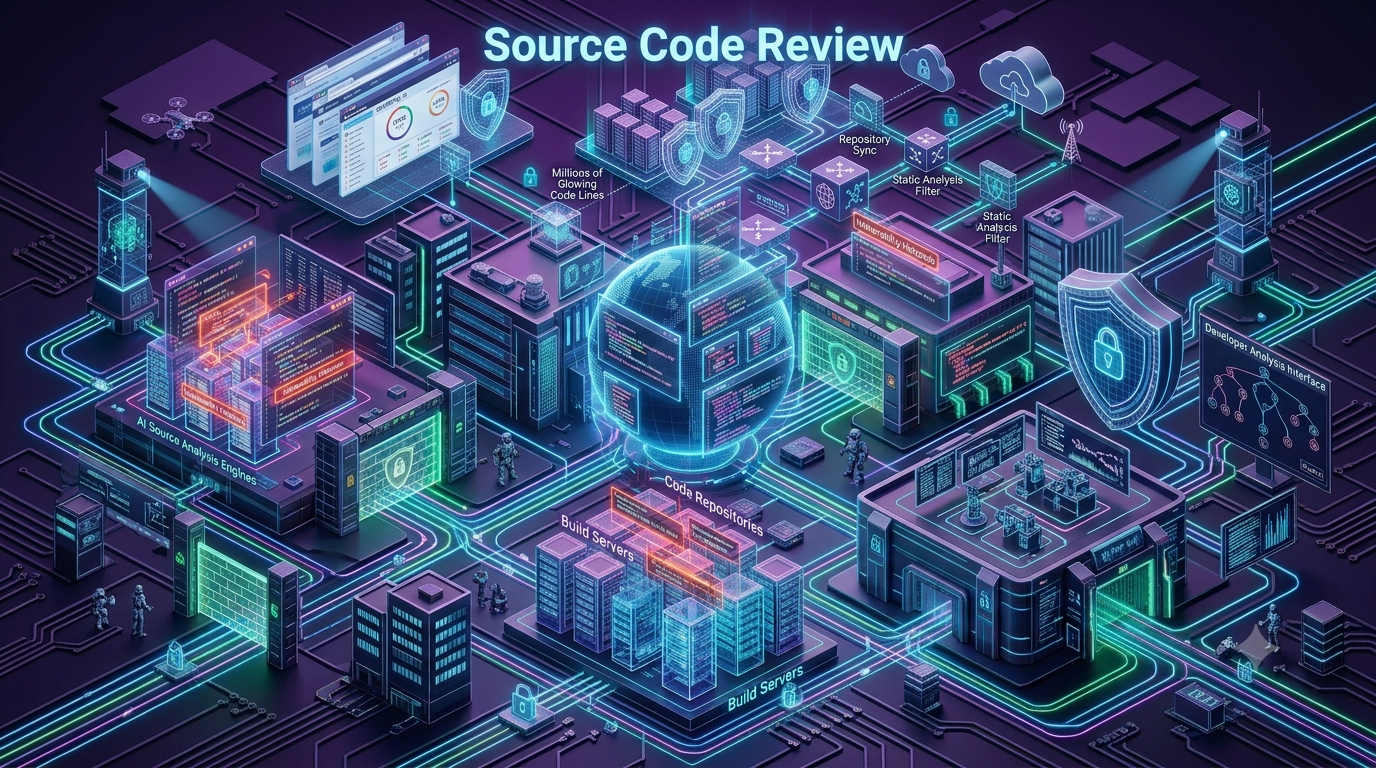
Source Code Review
Static code analysis to identify security vulnerabilities, coding errors, and adherence to standards.
Source code review, also referred to as static code analysis or secure code review, is the systematic examination of application source code without executing it. The primary objective is to identify and remediate security vulnerabilities, coding defects, and compliance violations before software reaches production. Unlike dynamic testing, which finds vulnerabilities during runtime execution, static code review allows us to trace every code path, examine all possible input permutations, and identify vulnerabilities that may only manifest under specific conditions. This makes it an indispensable component of any mature Software Development Lifecycle (SDLC), particularly for organizations building custom applications, handling sensitive data, or operating under regulatory compliance frameworks.
Security vulnerabilities discovered through source code review span injection flaws (SQL, NoSQL, LDAP, command injection), broken authentication implementations, insecure direct object references (IDOR), cross-site scripting (XSS) in server-side templates, hardcoded credentials and secrets, cryptographic misuses, insecure deserialization, and path traversal issues. We also identify code quality problems that contribute to security debt, including overly complex functions, insufficient input validation, missing output encoding, improper error handling that leaks sensitive information, and race conditions in concurrent code. Each finding is accompanied by the exact file location, line number, and a code-level explanation of the vulnerability mechanism.
Our review methodology combines automated static analysis security testing (SAST) tools with expert manual review. Automated tools excel at identifying known vulnerability patterns, coding standard violations, and dependency vulnerabilities (CVEs in third-party libraries). However, automated scanners cannot understand business logic, identify complex authorization flaws, or evaluate the security implications of custom authentication schemes. This is where our manual review provides critical value — our experienced security engineers trace data flows through the application, evaluate authentication and authorization logic, examine cryptographic implementations, and review API contracts for security assumptions that could be exploited. This dual approach identifies 70-90% more critical vulnerabilities than automation alone.
We review source code across all major programming languages and frameworks including C#, .NET, Java, Python, JavaScript/TypeScript, Node.js, Go, Rust, PHP, C/C++, and Solidity for smart contracts. For each engagement, we establish language-specific rules and custom SAST configurations tuned to your coding standards and technology stack. Beyond vulnerability discovery, we provide actionable remediation guidance with secure code examples, educate your development team on secure coding practices through inline comments and review sessions, and help establish secure coding standards and gating criteria for your CI/CD pipeline. The outcome is not just a list of bugs, but a measurable improvement in your development team's security capability and code quality.
How We Deliver
A structured methodology refined through hundreds of successful engagements.
Environment Setup & Tool Configuration
We establish a secure review environment and configure SAST tools (Semgrep, CodeQL, SonarQube, Checkmarx, or Fortify depending on your stack) with rulesets tuned to your application's language, framework, and coding standards. We also configure dependency scanners (Snyk, Dependabot, OWASP Dependency-Check) to identify known vulnerabilities in open-source and third-party libraries. Custom rules are created based on your application's specific architecture and business logic patterns.
Automated Static Analysis Scanning
Automated SAST tools scan the entire codebase to identify common vulnerability patterns, coding standard violations, and potential security weaknesses. We run multiple scanners to maximize coverage — each tool has different strengths and detection capabilities. Results are deduplicated and triaged automatically, with false positives flagged for manual verification. Parallel to SAST, we run secret scanning to detect hardcoded credentials, API keys, tokens, and other sensitive information embedded in source code or configuration files.
Manual Deep-Dive Code Review
Our security engineers perform line-by-line manual review of critical code paths including authentication and authorization logic, session management, input validation routines, cryptographic implementations, data access layers, and API endpoint handlers. We trace data flows from user input to persistent storage, examining every transformation for injection possibilities, encoding failures, and logic flaws. Special attention is given to business logic vulnerabilities that automated tools cannot detect, including privilege escalation paths, parameter tampering opportunities, and workflow bypasses.
Comprehensive Finding Analysis & Classification
Each confirmed vulnerability is classified by type using CWE (Common Weakness Enumeration) identifiers, scored using CVSS 4.0, and mapped to OWASP Top 10 categories. We determine the exploitability of each finding, identify the minimal proof-of-concept required to demonstrate impact, and assess the business risk considering data sensitivity and attack surface exposure. Findings are cross-referenced with related code areas to identify systemic issues rather than isolated defects.
Reporting, Developer Guidance & Fix Verification
We deliver a detailed report organized by severity with exact file paths, line numbers, vulnerable code snippets, and secure code replacement examples for every finding. Each issue includes an explanation of the vulnerability mechanism, potential business impact, and step-by-step remediation guidance designed for developers. After your team implements fixes, we perform targeted re-review to verify remediation completeness and check for regression issues introduced by the changes. We also provide a secure coding standards document tailored to your technology stack.
What You Receive
Every engagement delivers actionable insights and tangible outcomes.
Detailed Vulnerability Report
Comprehensive report with CWE-classified findings, CVSS 4.0 scores, exact file paths and line numbers, vulnerable code excerpts, and secure code replacement examples for every identified issue.
SAST & Dependency Scan Results
Consolidated output from all scanning tools with deduplicated findings, false positives flagged, and dependency vulnerability analysis including CVE references and remediation versions.
Secure Coding Guidelines
Customized secure coding standards document tailored to your technology stack, covering input validation, output encoding, authentication patterns, cryptography, and error handling best practices.
Proof-of-Concept Demonstrations
Working exploit demonstrations for critical and high-severity findings, showing step-by-step reproduction with request sequences and expected responses to validate business impact.
Key Benefits
Partner with SecureNexGen for results that matter.
Shift-Left Security
Identifying vulnerabilities during development rather than production reduces remediation costs by up to 30x and prevents security incidents before they can impact your users or operations.
Measurable Code Quality Improvement
Tracking vulnerability density, code complexity metrics, and secure coding compliance over successive reviews provides quantitative evidence of your development team's security maturity growth.
Developer Security Empowerment
Inline code review comments and collaborative remediation sessions transfer security knowledge to your development team, building long-term secure coding capability within your organization.
Faster Deployment Cycles
Establishing security gating criteria and automated SAST integration in your CI/CD pipeline enables confident, secure releases without manual security review bottlenecks at deployment time.
What's Covered
Comprehensive scope designed to leave no stone unturned.
Frequently Asked Questions
Common queries about our service delivery and process.
What is the difference between source code review and penetration testing?
Which programming languages and frameworks do you support?
How do you handle false positives from automated scanning tools?
How long does a source code review engagement typically take?
Can you integrate source code review into our CI/CD pipeline?
Ready to Get Started?
Contact our team to discuss your requirements and receive a tailored proposal.