Red Teaming
Adversarial simulation and breach testing to evaluate your organization's defensive capabilities.
Red teaming represents the most advanced form of security testing, simulating a full-scope, multi-vector attack by a sophisticated adversary to evaluate your organization's people, processes, and technology defenses as an integrated system. Unlike traditional penetration testing, which focuses on finding technical vulnerabilities within a defined scope, red teaming adopts the mindset, tools, and techniques of real-world threat actors — including advanced persistent threats (APTs), cybercrime syndicates, and state-sponsored attackers — to test your organization's ability to detect, respond to, and recover from a targeted attack. Our red team engagements are objective-driven campaigns with specific goals such as accessing sensitive data, achieving persistent access, or compromising critical systems.
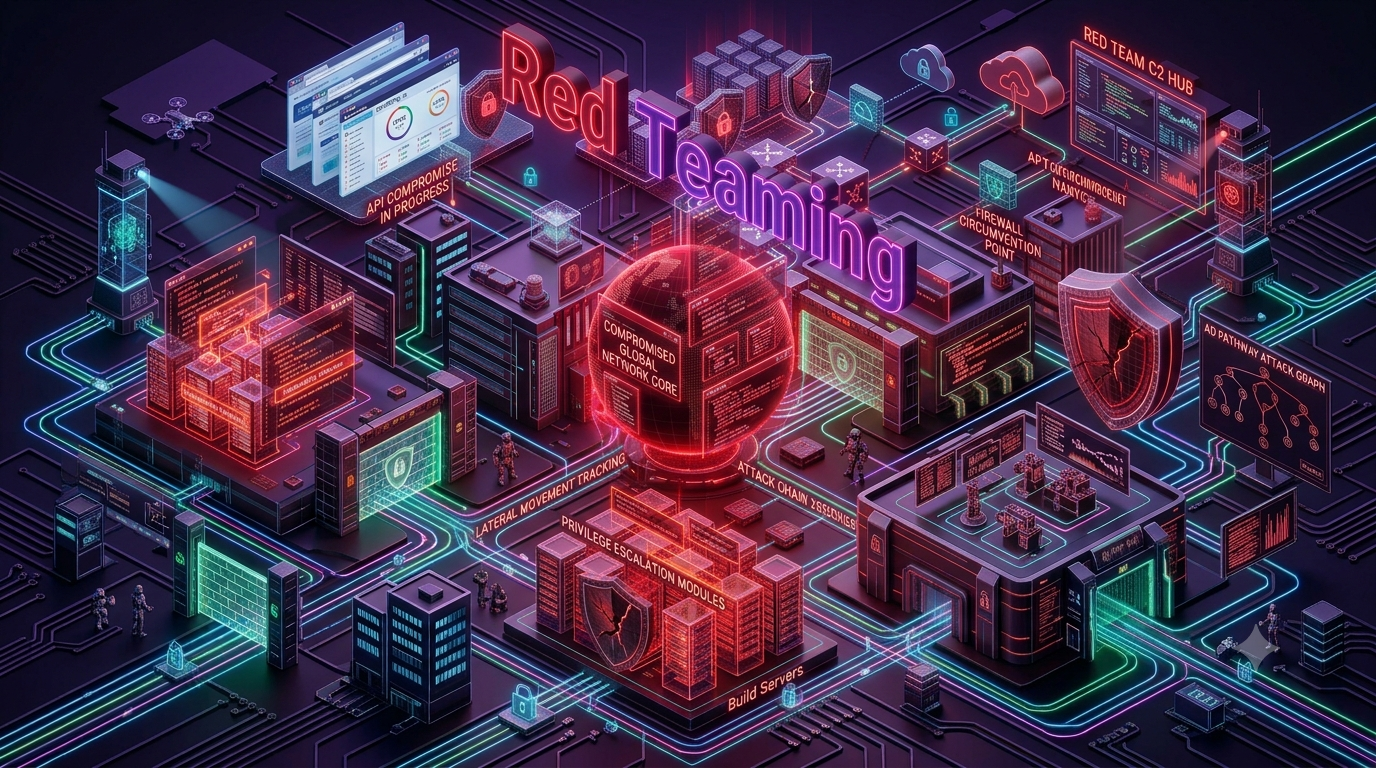
Our red team methodology encompasses multiple attack dimensions simultaneously. Technical attacks target your network perimeter, web applications, cloud infrastructure, and endpoint defenses using the latest exploitation techniques and custom tooling. Social engineering campaigns test your employees' security awareness through targeted phishing, vishing (voice phishing), smishing (SMS phishing), pretexting, and physical social engineering. Physical security testing evaluates your facilities' access controls, surveillance coverage, and security response procedures through controlled attempts to gain unauthorized physical access. By combining these vectors in coordinated campaigns, we simulate the multi-modal approach used by real attackers, revealing weaknesses that siloed testing approaches cannot uncover.
During the engagement, our team operates under a formal rules of engagement (ROE) that defines the campaign objectives, attack surface boundaries, prohibited actions, and escalation procedures. We maintain continuous communication with a designated blue team liaison and follow pre-agreed engagement deconfliction procedures to prevent confusion with actual threats. Our operations are conducted with operational security (OPSEC) measures that prevent our activities from being attributed to your organization. Adversary emulation is based on real threat actor TTPs (tactics, techniques, and procedures) mapped to the MITRE ATT&CK framework, ensuring that our testing reflects actual offensive tradecraft used by the threat groups most relevant to your industry and geographic region.
The culmination of a red team engagement is a comprehensive after-action report (AAR) and executive briefing that presents findings across all attack vectors, details the attack chains used, and provides a candid assessment of your detection and response capabilities. We highlight both successes (attacks that were detected and blocked) and failures (attacks that succeeded undetected), providing a balanced view of your defensive posture. Our recommendations span technology improvements (tooling gaps, configuration changes), process enhancements (incident response procedures, alert triage workflows), and human factors (security awareness training gaps, social engineering susceptibility). Many organizations also choose to conduct a purple team exercise following the red team engagement, where our red team collaborates directly with your blue team to transfer knowledge, improve detection rules, and enhance response procedures.
How We Deliver
A structured methodology refined through hundreds of successful engagements.
Reconnaissance & Intelligence Gathering
We conduct extensive open-source intelligence (OSINT) collection against your organization, including employee information gathering (LinkedIn, social media, corporate websites), technology stack fingerprinting, third-party and supply chain mapping, physical location reconnaissance, and dark web monitoring for leaked credentials. We build a detailed target profile including organizational structure, key personnel, technology assets, security vendors, and operational patterns that inform our attack planning.
Initial Access & Foothold Establishment
Using intelligence gathered, we launch coordinated initial access attempts across multiple vectors. Technical vectors include exploiting internet-facing vulnerabilities, credential stuffing against VPN and webmail portals, and weaponized attachments. Social engineering includes tailored phishing campaigns with pretexts relevant to your industry and employee roles. Physical vectors may include tailgating, lock picking, or badge cloning attempts. The goal is to establish a persistent foothold in your environment using techniques that mimic your actual threat landscape.
Lateral Movement & Privilege Escalation
Once initial access is achieved, we move laterally across your network using techniques including pass-the-hash, pass-the-ticket (Kerberos), token impersonation, remote service exploitation (PsExec, WMI, SSH, WinRM), and PowerShell remoting. Privilege escalation targets local administrator accounts, service accounts, and domain admin privileges through credential dumping (Mimikatz, LSASS), token theft, ACL abuse, and Active Directory exploitation. We operate using living-off-the-land (LotL) techniques to minimize tooling footprint and evade detection.
Persistence & Objective Achievement
We establish persistence mechanisms appropriate to the engagement objectives, such as scheduled tasks, WMI event subscriptions, service installations, registry modifications, or web shells. We then pursue the primary campaign objective — which may include accessing sensitive databases, exfiltrating controlled data samples, compromising critical systems (AD, backup servers, CI/CD pipelines), or demonstrating financial fraud scenarios. All objectives are pursued while maintaining OPSEC and attempting to evade your detection controls. Achieved objectives are documented with evidence chains.
Debrief, Reporting & Purple Teaming
The engagement concludes with a controlled deconfliction and remediation phase where all persistence mechanisms are removed. We deliver a comprehensive after-action report covering the full attack chain, detection opportunities (both alerts that fired and those that should have), and prioritized recommendations. For organizations opting for purple team follow-up, our red team works directly with your blue and SOC teams to share TTP details, co-develop detection signatures, tune SIEM rules, and conduct joint tabletop exercises to improve future response effectiveness.
What You Receive
Every engagement delivers actionable insights and tangible outcomes.
After-Action Report
Comprehensive report detailing the full attack chain, achieved objectives, detection gaps, and prioritized recommendations for improving people, process, and technology defenses.
Attack Simulation Timeline
Visual timeline of all activities conducted during the engagement mapped against your detection and response events, showing dwell time and detection latency for each phase.
Detection Gap Analysis
Detailed assessment of detection coverage gaps mapped to MITRE ATT&CK techniques, including specific recommendations for alert rules, logging improvements, and tool configurations.
Executive Briefing Deck
Board-ready presentation summarizing campaign outcomes, risk exposure quantification, ROI of security investments, and strategic roadmap for defense enhancement.
Key Benefits
Partner with SecureNexGen for results that matter.
Real-World Attack Simulation
Unlike point-in-time penetration tests, red teaming evaluates your entire security ecosystem under realistic, multi-vector attack conditions that mirror actual adversary behavior.
Coordinated Defense Validation
Tests detection, response, and recovery capabilities simultaneously, revealing gaps in processes and team coordination that technical testing alone cannot identify.
MITRE ATT&CK Mapping
All TTPs are mapped to the MITRE ATT&CK framework, providing a standardized taxonomy for understanding attack patterns and benchmarking against industry threat intelligence.
Purple Team Integration
Optional purple team phase transfers red team insights directly to your blue team, enabling rapid detection rule development and SOC capability improvement.
What's Covered
Comprehensive scope designed to leave no stone unturned.
Frequently Asked Questions
Common queries about our service delivery and process.
How is red teaming different from penetration testing?
Will your testing trigger our security alerts or law enforcement?
How long does a red team engagement typically last?
What safety measures are in place to prevent actual damage?
What qualifications do your red team operators hold?
Ready to Get Started?
Contact our team to discuss your requirements and receive a tailored proposal.