RAG Security Testing
Security audits for Retrieval-Augmented Generation systems, focusing on data poisoning, retrieval manipulation, and output integrity.
Retrieval-Augmented Generation has rapidly become the predominant architecture for production AI applications, enabling LLMs to access external knowledge bases, document stores, and databases to ground their responses in factual, up-to-date information. By retrieving relevant context at inference time, RAG systems overcome the limitations of static training data and reduce hallucinations, making them ideal for enterprise applications requiring accuracy and traceability. However, this architecture introduces a complex attack surface where security vulnerabilities can exist at any point in the retrieval-generation pipeline. The ingestion pipeline, vector database, retrieval mechanism, and context integration layer each present unique risks that must be systematically assessed and hardened against adversarial manipulation.
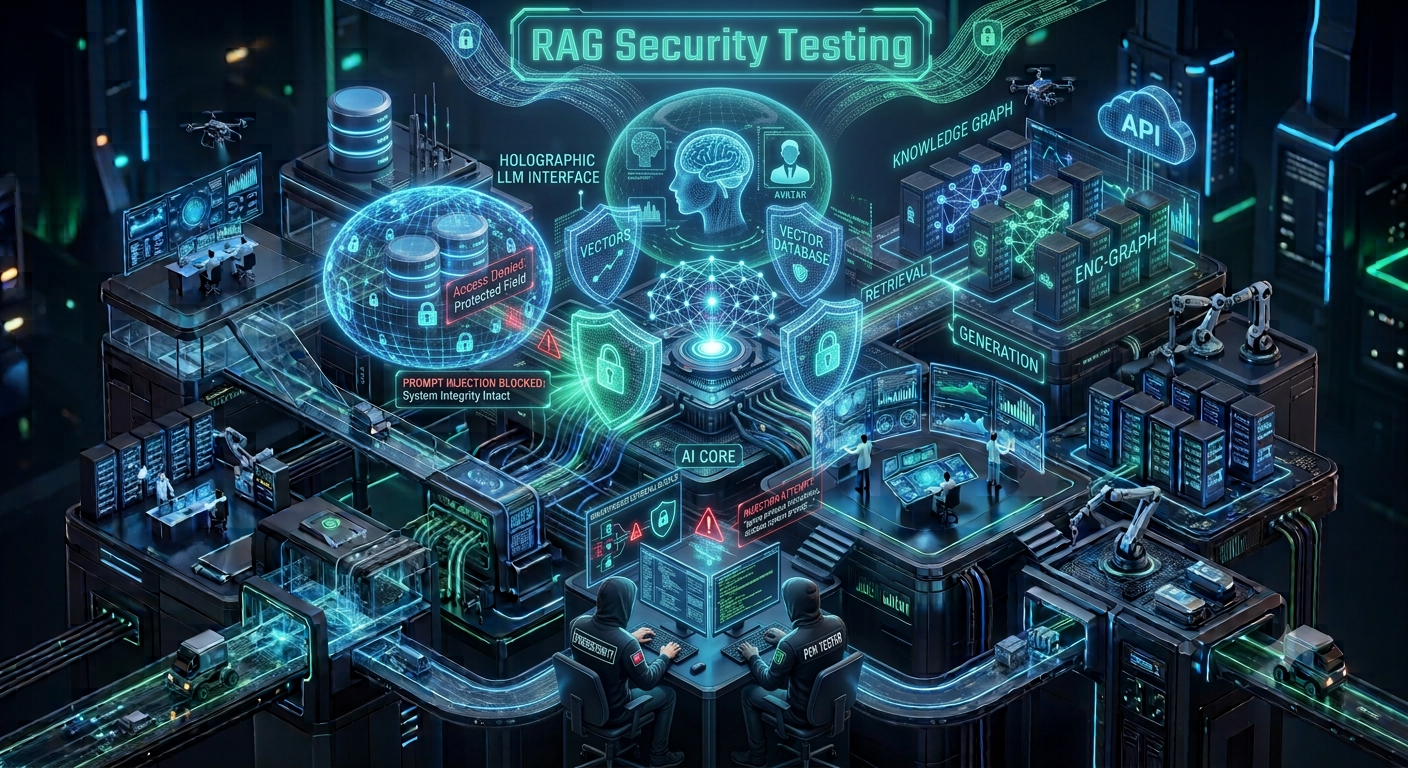
The RAG security threat model encompasses a range of sophisticated attack vectors. Data poisoning attacks target the knowledge base itself, where adversaries inject malicious documents that, when retrieved, influence model outputs toward attacker-desired outcomes. Retrieval manipulation attacks exploit weaknesses in the embedding and similarity search process to cause the system to retrieve attacker-controlled content over legitimate sources. Context injection attacks leverage the retrieved context to insert adversarial instructions that subvert model behavior, similar to indirect prompt injection. Document-level attacks can embed hidden instructions or manipulate chunk boundaries to control what content is retrieved and how it is interpreted. These threats are compounded in multi-source RAG systems where documents from different trust domains are combined, creating cross-contamination risks.
Our RAG Security Testing methodology provides end-to-end coverage of the entire RAG pipeline, from document ingestion through retrieval, context assembly, and output generation. We begin by mapping your RAG architecture to identify all components including data sources, ingestion pipelines, chunking strategies, embedding models, vector databases, retrieval algorithms, and context integration patterns. Our testing covers the ingestion layer for vulnerabilities such as document injection, metadata manipulation, and chunk boundary attacks. The retrieval layer is tested for embedding manipulation, similarity search poisoning, and index corruption risks. The generation layer is assessed for context injection, source citation manipulation, and output integrity issues. We also evaluate the security of the vector database itself, including access controls, encryption, and isolation properties.
The results of our engagement provide a comprehensive security assessment of your RAG system with prioritized remediation guidance tailored to your specific architecture and use cases. You will receive a detailed audit report documenting all vulnerabilities discovered across the RAG pipeline, complete with attack scenarios, proof-of-concept demonstrations, and risk ratings. We provide secure RAG architecture blueprints that demonstrate how to design retrieval systems resistant to poisoning and manipulation attacks. Our deliverable includes hardened ingestion pipeline configurations, secure chunking strategies, retrieval validation patterns, and monitoring rules to detect RAG-specific attacks in production. With our assessment, you can deploy RAG systems that provide the accuracy and traceability benefits of grounded generation without compromising on security.
How We Deliver
A structured methodology refined through hundreds of successful engagements.
RAG Architecture Mapping
We conduct a comprehensive mapping of your RAG system architecture, documenting all data sources, ingestion pipelines, preprocessing steps, chunking strategies, embedding models, vector database configurations, retrieval algorithms, reranking mechanisms, and context integration methods. This mapping identifies every component and data flow that could be targeted by adversaries.
Ingestion Pipeline Security Testing
The document ingestion pipeline is tested for vulnerabilities including document injection where malicious files are uploaded to the knowledge base, metadata manipulation where document attributes are altered to influence retrieval, chunk boundary attacks that control how content is split, and encoding-based attacks that hide content from preprocessing while affecting retrieval behavior.
Retrieval Manipulation Assessment
We test the retrieval mechanism for susceptibility to manipulation including embedding collision attacks that cause attacker-controlled content to match diverse queries, similarity search poisoning that alters ranking results, index corruption that causes incorrect or incomplete retrieval, and filter bypass techniques that circumvent access controls on sensitive documents in the knowledge base.
Context Injection & Integrity Testing
The context assembly and integration layer is tested for injection vulnerabilities where retrieved documents contain instructions that subvert model behavior, source citation manipulation that undermines output trustworthiness, cross-source contamination where content from untrusted sources influences responses to queries about trusted sources, and context window overflow attacks that suppress legitimate retrieved content.
Remediation & Hardening
All findings are compiled into a prioritized remediation plan with specific guidance for each layer of the RAG pipeline. We provide secure ingestion patterns, hardened vector database configurations, retrieval validation techniques, context sanitization methods, and monitoring and detection rules. We validate critical remediations through retesting to confirm effectiveness.
What You Receive
Every engagement delivers actionable insights and tangible outcomes.
RAG Security Audit Report
Comprehensive audit report documenting all vulnerabilities across the RAG pipeline including ingestion, retrieval, context assembly, and generation layers. Each finding includes detailed attack descriptions, proof-of-concept demonstrations, risk ratings, and specific remediation steps with code-level recommendations.
Secure RAG Architecture Blueprint
Reference architecture document outlining secure design patterns for RAG systems, including data source trust classification, ingestion pipeline security controls, retrieval validation mechanisms, and context integrity verification. The blueprint is tailored to your specific vector database and embedding model choices.
Ingestion Security Guidelines
Detailed guidelines for securing document ingestion pipelines including document validation and sanitization procedures, metadata integrity controls, chunking security best practices, and data provenance tracking. Includes configuration templates for common ingestion frameworks and document processing tools.
Retrieval Integrity Monitor
A monitoring framework designed to detect retrieval anomalies and potential manipulation attacks in production. Includes baseline profiling of normal retrieval patterns, anomaly detection rules for unusual ranking distributions, alert thresholds for retrieval quality degradation, and automated incident response playbooks for suspected attacks.
Key Benefits
Partner with SecureNexGen for results that matter.
End-to-End Pipeline Coverage
Complete security assessment covering every stage of the RAG pipeline from document ingestion through vector storage, retrieval, context assembly, and output generation. No component is overlooked, ensuring comprehensive protection against multi-stage attacks targeting different pipeline layers.
Data Integrity Assurance
Verification that your knowledge base content remains untainted by adversarial documents and that retrieval returns authentic, unmanipulated content. Protection against data poisoning ensures that your RAG system continues to provide trustworthy, accurate information grounded in verified sources.
Output Reliability
Ensuring that generated outputs faithfully reflect the retrieved context without manipulation from injected instructions or compromised source content. Protection against context injection guarantees that your AI applications produce reliable outputs that can be traced back to verified sources.
Production Monitoring Readiness
Deployable monitoring and detection capabilities that provide ongoing visibility into RAG pipeline security. Early warning of retrieval anomalies and potential attacks enables rapid response before adversaries can achieve their objectives or cause significant business impact.
What's Covered
Comprehensive scope designed to leave no stone unturned.
Frequently Asked Questions
Common queries about our service delivery and process.
What is RAG data poisoning and how do you test for it?
How does RAG security differ from standard LLM penetration testing?
What are the most critical security controls for a RAG system?
What vector databases and embedding models do you support?
How do you test for context injection in RAG systems?
Ready to Get Started?
Contact our team to discuss your requirements and receive a tailored proposal.