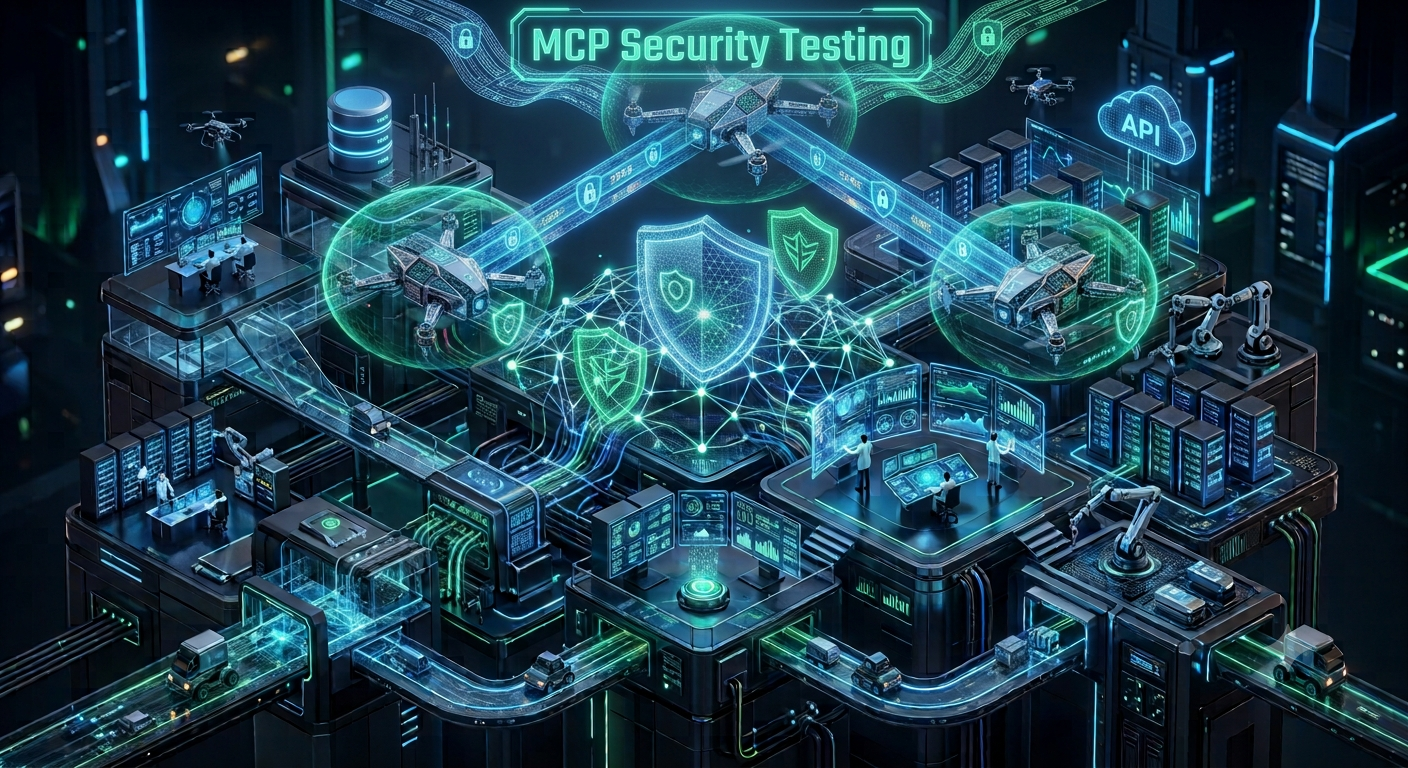
MCP Security Testing
Model Context Protocol security assessments and validation for AI-powered applications and tool-integrated systems.
The Model Context Protocol (MCP) has emerged as a critical standard for connecting AI models with external tools, data sources, and services, enabling a new generation of context-aware AI applications. As organizations adopt MCP to power their AI ecosystems, the security implications of this protocol demand rigorous examination. MCP servers act as gateways between AI models and sensitive resources, handling authentication, authorization, data transformation, and access control decisions. A vulnerability in an MCP implementation can expose backend systems, leak confidential context data, or allow unauthorized tool execution with potentially severe consequences. Understanding and validating the security properties of your MCP infrastructure is essential before deploying AI applications that depend on these connections.
The threat landscape surrounding MCP implementations is diverse and rapidly evolving. Attackers can exploit insecure server configurations to bypass authentication controls and gain unauthorized access to protected tools and resources. Message tampering during MCP communication can alter context data flowing between models and servers, leading to manipulated AI outputs or unauthorized actions. Resource descriptor enumeration attacks can leak information about available tools and their parameters, providing attackers with reconnaissance data for targeted exploitation. Additionally, insufficient validation of server responses can lead to context injection attacks where malicious data from a compromised server subverts model behavior. These threats require a specialized security testing approach that combines protocol-level analysis with application-layer assessment.
Our MCP Security Testing methodology provides comprehensive coverage across all layers of the MCP stack. We begin with protocol-level analysis, examining the implementation's adherence to the MCP specification and identifying deviations that could introduce security weaknesses. We then conduct in-depth authentication and authorization testing, evaluating how servers verify client identities, enforce access controls, and manage session security. Our resource and tool security assessment examines each exposed capability for vulnerabilities including parameter injection, excessive data exposure, path traversal, and insufficient access scoping. We also perform transport security evaluation, assessing TLS configuration, certificate validation, and protection against network-level attacks such as replay and man-in-the-middle.
The deliverable from our engagement provides a complete security picture of your MCP implementation with prioritized remediation guidance. You will receive a detailed assessment report documenting all vulnerabilities found, complete with attack scenarios, proof-of-concept code, and CVSS 4.0 severity scores. Our MCP security hardening guide provides specific configuration recommendations, code-level fixes for common implementation pitfalls, and architectural patterns for building secure MCP servers. We also deliver integration test scripts that can be incorporated into your CI/CD pipeline to automatically validate MCP security controls with every deployment. With our assessment, you can confidently leverage MCP to build powerful AI applications while maintaining strong security boundaries between models and your critical systems.
How We Deliver
A structured methodology refined through hundreds of successful engagements.
Protocol Conformance Review
We conduct a detailed review of your MCP implementation against the official protocol specification, identifying deviations, ambiguous implementations, and custom extensions that may introduce security weaknesses. This includes examining message formatting, lifecycle management, error handling, and capability negotiation for compliance and security implications.
Authentication & Authorization Testing
Comprehensive testing of client and server authentication mechanisms including OAuth 2.0 flows, API key validation, JWT handling, and certificate-based authentication. We test for authorization bypasses, privilege escalation, session fixation, token reuse, and insufficient access control enforcement across all MCP resources and tools.
Resource & Tool Security Audit
Each resource and tool exposed through MCP is audited for security vulnerabilities including parameter injection, path traversal, resource enumeration, excessive data exposure, type confusion, and denial-of-service conditions. We assess whether resource URIs leak sensitive information and whether tool parameters are properly validated and sanitized.
Transport Security Evaluation
The transport layer security of MCP communications is evaluated including TLS configuration strength, certificate chain validation, cipher suite selection, and protection against protocol downgrade attacks. For WebSocket-based transports, we assess connection origin validation, message integrity, and resistance to replay and injection attacks.
Context Integrity & Isolation Testing
We test the integrity and isolation properties of context data flowing through MCP channels, assessing whether context from different sessions or users can be cross-contaminated. We evaluate how the server handles concurrent contexts, context persistence mechanisms, and whether context data can be manipulated by unauthorized parties during transit or storage.
What You Receive
Every engagement delivers actionable insights and tangible outcomes.
MCP Security Assessment Report
Comprehensive report documenting all vulnerabilities discovered across your MCP implementation, including protocol-level findings, authentication flaws, resource vulnerabilities, and transport security issues. Each finding includes detailed technical descriptions, proof-of-concept demonstrations, and remediation guidance.
Secure MCP Implementation Guide
A practical guide with secure configuration templates, code snippets for common MCP implementation patterns, authentication and authorization best practices, and input validation strategies. Includes architecture patterns for production-grade MCP server deployment with defense-in-depth principles.
CI/CD Integration Tests
A suite of automated security tests designed for integration into your CI/CD pipeline. These tests validate MCP authentication, authorization, input validation, and transport security controls with every build, providing continuous security assurance as your MCP implementation evolves.
Threat Model & Attack Trees
Detailed threat models specific to your MCP deployment, including attack trees that map potential attacker paths from initial access through privilege escalation and data exfiltration. Includes risk ratings and recommended control mappings to mitigate each identified threat scenario.
Key Benefits
Partner with SecureNexGen for results that matter.
Protocol-Level Assurance
Deep validation of your MCP implementation against the protocol specification ensures that security properties assumed by the protocol are properly enforced, preventing subtle vulnerabilities that arise from incorrect or incomplete implementations.
Integration Security
Comprehensive security validation of all MCP server integrations with backend systems, databases, and external APIs ensures that the MCP layer does not become a bypass route around existing security controls protecting your critical assets.
Continuous Validation
Automated security tests integrated into your development pipeline provide continuous validation that security controls remain effective as your MCP implementation changes, preventing regression of previously fixed vulnerabilities.
Developer Confidence
Empower your development teams to build MCP-based applications with confidence, knowing that security best practices are embedded in their implementation patterns and that automated guardrails prevent common security mistakes.
What's Covered
Comprehensive scope designed to leave no stone unturned.
Frequently Asked Questions
Common queries about our service delivery and process.
What exactly is MCP and why does it need specialized security testing?
What are the most common MCP security vulnerabilities you find?
How does MCP security testing differ from API security testing?
Can you test MCP implementations built with any SDK or framework?
How do you test MCP security in a CI/CD pipeline?
Ready to Get Started?
Contact our team to discuss your requirements and receive a tailored proposal.