Configuration Review & Hardening
System configuration audit and hardening to eliminate attack vectors and reduce surface area.
The configuration of a system plays such a pivotal role in its security. A misconfiguration will always leave a system vulnerable to a cyber attack and will sometimes lead to bypassing of security controls altogether. Insecure configurations come in the form of insecure services, use of default credentials, and missing important patches. System hardening on the other hand is the process of making a computer system more secure by eliminating potential attack vectors and reducing the attack surface. It focuses on levels of privilege, user groups (admins and standard user accounts), access to storage media, shared files, and the right to change/adjust system settings. At SecureNexGen, we perform a deep-dive configuration audit across operating systems, middleware, databases, and network devices, identifying every deviation from security best practices and industry benchmarks such as CIS Benchmarks, NIST SP 800-53, and ISO 27001 controls.
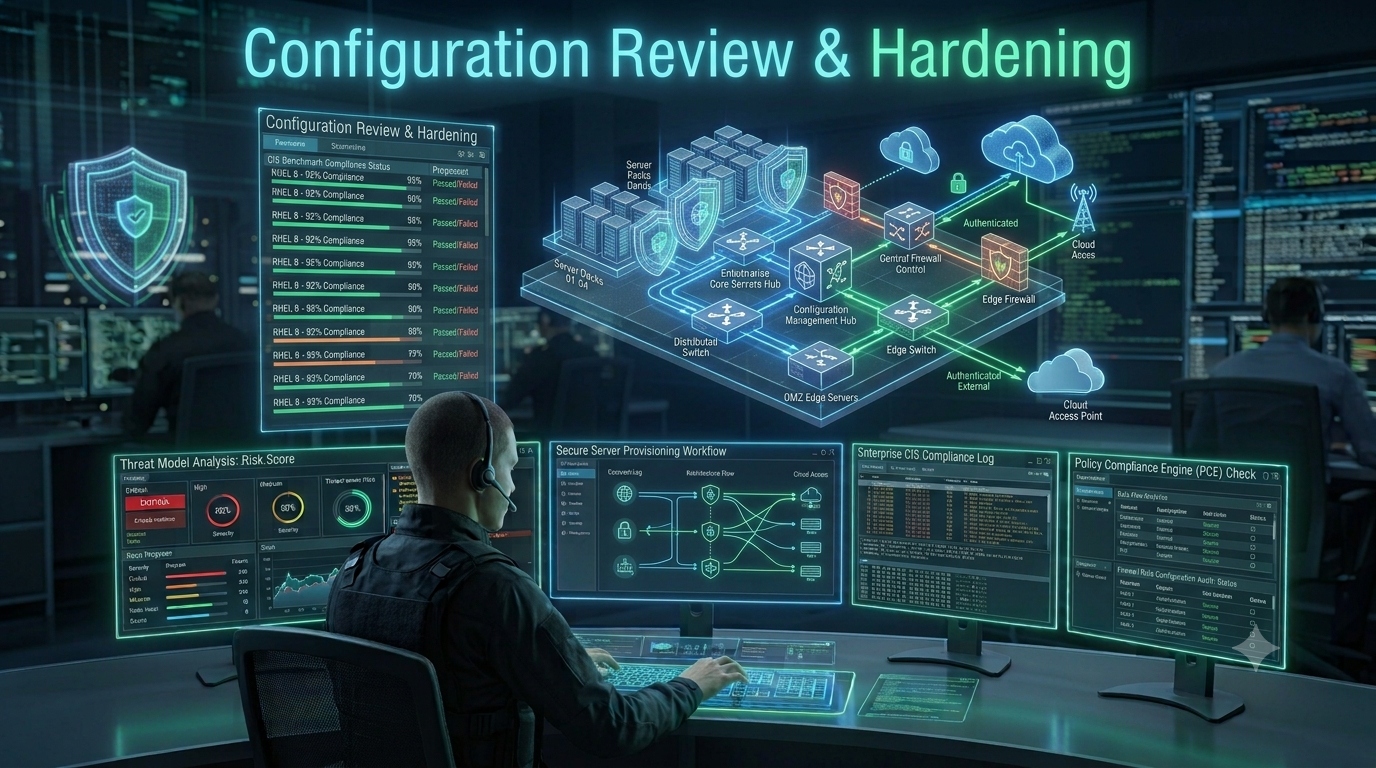
Common misconfigurations we uncover include unnecessary open ports, weak cipher suites, overly permissive file system permissions, unpatched software versions, exposed management interfaces, and disabled logging or auditing mechanisms. Many organizations unknowingly run services that are not required for business operations, each representing an additional entry point for adversaries. Default credentials remain one of the most exploited weaknesses in enterprise environments, often found on network appliances, databases, and cloud management consoles. Our review systematically enumerates every running service, listening port, and active account, then cross-references each against the organization's operational requirements and industry hardening guidelines.
The hardening process extends beyond technical controls to include policy-level improvements. We examine how user privileges are assigned, whether the principle of least privilege is enforced, how administrative access is controlled and monitored, and whether separation of duties is implemented for critical systems. Hardening also covers storage media and shared file access to prevent unauthorized data disclosure or tampering. We assess encryption at rest and in transit, authentication mechanisms, password policies, session management, and audit logging configurations. The goal is to create a defense-in-depth posture where each layer of the system independently enforces security, making it exponentially harder for an attacker to achieve their objectives.
Beyond immediate risk reduction, configuration review and system hardening directly contribute to regulatory compliance. Frameworks such as PCI DSS, HIPAA, SOC 2, and ISO 27001 all mandate secure configuration baselines and regular hardening reviews. Organizations that undergo our hardening process typically see a dramatic reduction in their attack surface, improved system performance from the removal of unnecessary services, and faster incident response due to comprehensive audit logging. Optimal system functionality is restored as removing unnecessary programs and disabling unwanted services ensures the system runs with fewer interruptions and reduced resource contention.
How We Deliver
A structured methodology refined through hundreds of successful engagements.
Discovery & Inventory
We begin by cataloguing every asset in scope — servers, workstations, network appliances, cloud instances, containers, and databases. Automated discovery tools combined with manual verification create a comprehensive inventory that captures operating system versions, installed software, running services, open ports, active user accounts, and existing security controls. This baseline inventory is essential for understanding the full attack surface and identifying assets that may have been forgotten or shadow IT deployments.
Baseline Comparison
We compare the discovered configuration against industry-standard security benchmarks such as CIS Benchmarks, DISA STIGs, and NIST SP 800-53. Each configuration item is scored against the benchmark, with deviations flagged as findings. We also evaluate the organization's own security policies and configuration standards, identifying gaps between documented policy and actual implementation. The comparison produces a detailed gap analysis report with severity ratings for each finding.
Vulnerability Mapping
Each misconfiguration is mapped to specific threats, attack techniques (MITRE ATT&CK), and potential business impact. For example, an open RDP port mapped to T1021 (Remote Services) with a risk rating based on asset criticality, network segmentation, and existing compensating controls. This step ensures that remediation efforts are prioritized based on actual risk rather than theoretical severity, enabling the organization to focus resources on the most impactful hardening actions first.
Hardening & Remediation
We implement or guide the implementation of hardening measures including: disabling unnecessary services and ports, removing or renaming default accounts, enforcing strong password policies and MFA, applying the principle of least privilege to user and service accounts, configuring file system permissions and encryption, enabling comprehensive audit logging and alerting, applying security patches, and hardening network device configurations. Each change is documented, tested in a staging environment where possible, and scheduled to minimize operational disruption.
Verification & Continuous Monitoring
Post-hardening, we perform a fresh round of scanning and manual verification to confirm all controls are correctly implemented and no new issues have been introduced. We validate that required business services continue to function correctly. A hardened baseline configuration is documented and provided as a reference for future deployments. We also establish continuous monitoring controls — including file integrity monitoring, configuration drift detection, and periodic review schedules — to ensure the system remains hardened over time.
What You Receive
Every engagement delivers actionable insights and tangible outcomes.
Hardening Assessment Report
Comprehensive documentation of all findings, risk ratings, and prioritized remediation recommendations across every asset reviewed.
Hardened Baseline Images
CIS-aligned golden images and infrastructure-as-code templates (Terraform, Ansible, DSC) for repeatable secure deployments.
Security Policy Updates
Updated configuration standards, password policies, access control matrices, and operational security procedures tailored to your environment.
Compliance Mapping Matrix
Cross-reference of hardening controls to regulatory requirements (PCI DSS, HIPAA, ISO 27001, SOC 2, NIST) for audit evidence readiness.
Key Benefits
Partner with SecureNexGen for results that matter.
Reduced Attack Surface
Eliminating unnecessary services, closing unused ports, removing default accounts, and applying least-privilege access controls significantly shrinks the exploitable surface available to adversaries.
Regulatory Compliance
Meet the secure configuration requirements of PCI DSS Requirement 2, HIPAA Security Rule, ISO 27001 Annex A.8, NIST SP 800-53 CM controls, and other compliance frameworks.
Optimal System Performance
Removing unnecessary software and disabling unused services frees up CPU, memory, and storage resources, reduces boot times, and minimizes the attack surface of third-party components.
Faster Incident Response
Comprehensive audit logging and file integrity monitoring established during hardening provide security teams with the visibility needed to detect, investigate, and respond to incidents rapidly.
What's Covered
Comprehensive scope designed to leave no stone unturned.
Frequently Asked Questions
Common queries about our service delivery and process.
What is the difference between a vulnerability assessment and a configuration review?
Which benchmarks and standards do you use for configuration review?
How long does a typical configuration review and hardening engagement take?
Will system hardening break my applications?
How do you handle configuration drift after the engagement ends?
Ready to Get Started?
Contact our team to discuss your requirements and receive a tailored proposal.